Market entry assessment: choose the site first, then the category
Market entry does not start with “which country is hot”; it starts with comparing your category across multiple sites: demand size, growth, price bands, competitive concentration and fulfillment costs. NWi CrossborderGo puts multi-marketplace, multi-site market data under one methodology, helping teams set their entry order.
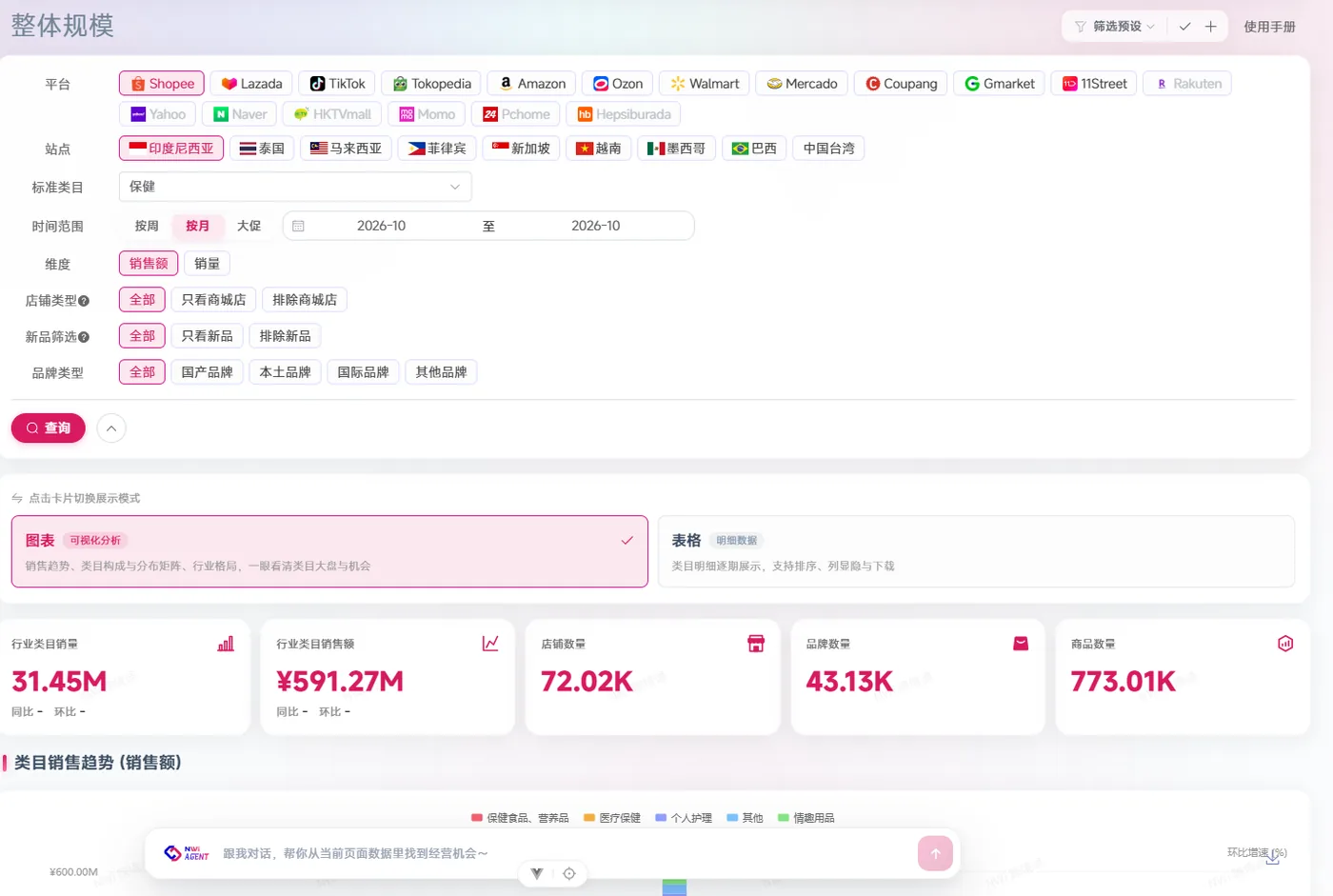
How to do it
List candidate markets
List 5–8 candidate markets by marketplace and site; do not expand too broadly at the start.
Compare side by side
Put candidate markets in one table using sales, growth, average price, brand concentration and price bands.
Calculate entry costs
Add logistics, duties, compliance, returns and local operating costs into a unit contribution model.
Choose the first site and stock plan
Choose the market with sufficient demand, accessible competition and coverable costs, and test with a small batch first.
What you get
Rank the first and second sites
Write conclusions into a recomputable table instead of leaving them in individual experience.
Avoid mistaking “a large market” for “a market that suits me”
Write conclusions into a recomputable table instead of leaving them in individual experience.
Put entry costs in the same table
Write conclusions into a recomputable table instead of leaving them in individual experience.
Which metrics to use
| Metric | Definition |
|---|---|
| Market size | Category sales/units, split by site. |
| Growth | Year-over-year/period-over-period, with the period stated. |
| Competitive concentration | Share of category sales held by leading brands or shops. |
| Price bands | Share of sales or units by price band. |
Related pages
Frequently asked questions
What should I look at first in a market entry assessment?
Start with demand size and growth, then competition concentration and price bands, and finally fulfillment and compliance costs. Looking only at market size can lead to misjudgment.
Which Southeast Asian country should I choose first?
There is no universal answer. Compare the same category across sites such as Indonesia, Thailand, Vietnam and the Philippines on size, price bands and competition, then factor in your supply chain and fulfillment capability.
Can data replace local research?
No. Data can narrow the scope, but local compliance, channels, consumer preferences and fulfillment details still need to be verified on the ground or with service providers.
What stage is it suitable for?
It suits teams preparing to enter a new market or expand from one marketplace to multiple marketplaces; teams already operating locally can use it for reviews and expansion.
Bring your scenario to us
We will use your category and marketplace to demo how far this process can go.
E-commerce data, methods and reports
Explore NWi EC Data product pages, platform coverage, data definitions and published research. Each source states its scope, definitions and limits.